Georgia rewards travelers who arrive prepared. From understanding the supra feast culture to navigating marshrutka timetables and knowing when to buy travel insurance, these practical tips for visiting Georgia in 2026 will help you travel smarter, safer, and more enjoyably.
Before You Go – Pre-Trip Preparation
Check Your Visa Status
The very first step. Citizens of 95+ countries (US, UK, EU, Canada, Australia, etc.) can enter Georgia visa-free for up to 365 days – no action needed. If your nationality is not on the visa-free list, apply for the Georgia e-Visa at evisa.gov.ge at least 2-3 weeks before departure. The fee is $20 + $15 DuVerify, and processing takes up to 5 business days.
Get Travel Insurance
This is not optional in Georgia – it is legally required and enforced at the border. All visitors must carry valid health and accident insurance covering their entire stay. The European EHIC card does not work in Georgia. Purchase comprehensive international travel insurance from any major provider before you fly. See the full details on our Georgia entry requirements page.
Download Offline Maps
Maps.me and Google Maps both work well in Georgia with offline maps downloaded. This is especially important outside Tbilisi where data connectivity can be patchy in mountain areas like Kazbegi, Svaneti, and Tusheti.
Learn a Few Georgian Words
Georgians are exceptionally warm toward visitors who make any effort with their language:
- Gamarjoba (ga-mar-JO-ba) – Hello
- Madloba (mad-LO-ba) – Thank you
- Ara (a-RA) – No
- Diakh (di-AKH) – Yes
- Gaumarjos (gau-mar-JOS) – Cheers (essential for toasts)
Money and Payments in Georgia
The Georgian Lari (GEL) is the local currency. Exchange USD or EUR at banks or official exchange kiosks – airport rates are poor. ATMs are widely available in Tbilisi and larger cities; carry cash in rural and mountain areas where ATMs are scarce.
Credit cards work at most hotels, restaurants, and shops in Tbilisi and tourist centers. Smaller guesthouses and rural eateries are cash only. Tipping: 10% is appropriate in restaurants; not always expected in casual local spots.
Getting Around Georgia
Marshrutkas (Shared Minibuses)
The backbone of Georgian public transport. Cheap, go almost everywhere, but leave when full (not on a set schedule). For major routes (Tbilisi-Kazbegi, Tbilisi-Batumi), a rough schedule applies. Buy tickets at the relevant bus station. Comfortable enough for most distances.
Car Rental
Essential for exploring rural Georgia, wine villages, and off-the-beaten-path destinations. Roads range from excellent (main highways) to rough mountain tracks. An international driver’s license is recommended. Fuel is affordable. Driving culture is assertive – be alert.
Taxis and Ride Apps
Bolt works well in Tbilisi, Kutaisi, and Batumi. Yandex is popular too. For intercity trips, negotiate price before getting in an unmarked taxi (or use marshrutka instead). Tbilisi to Mtskheta by taxi: around 25-40 GEL.
Food and Drink Tips
Embrace the Supra
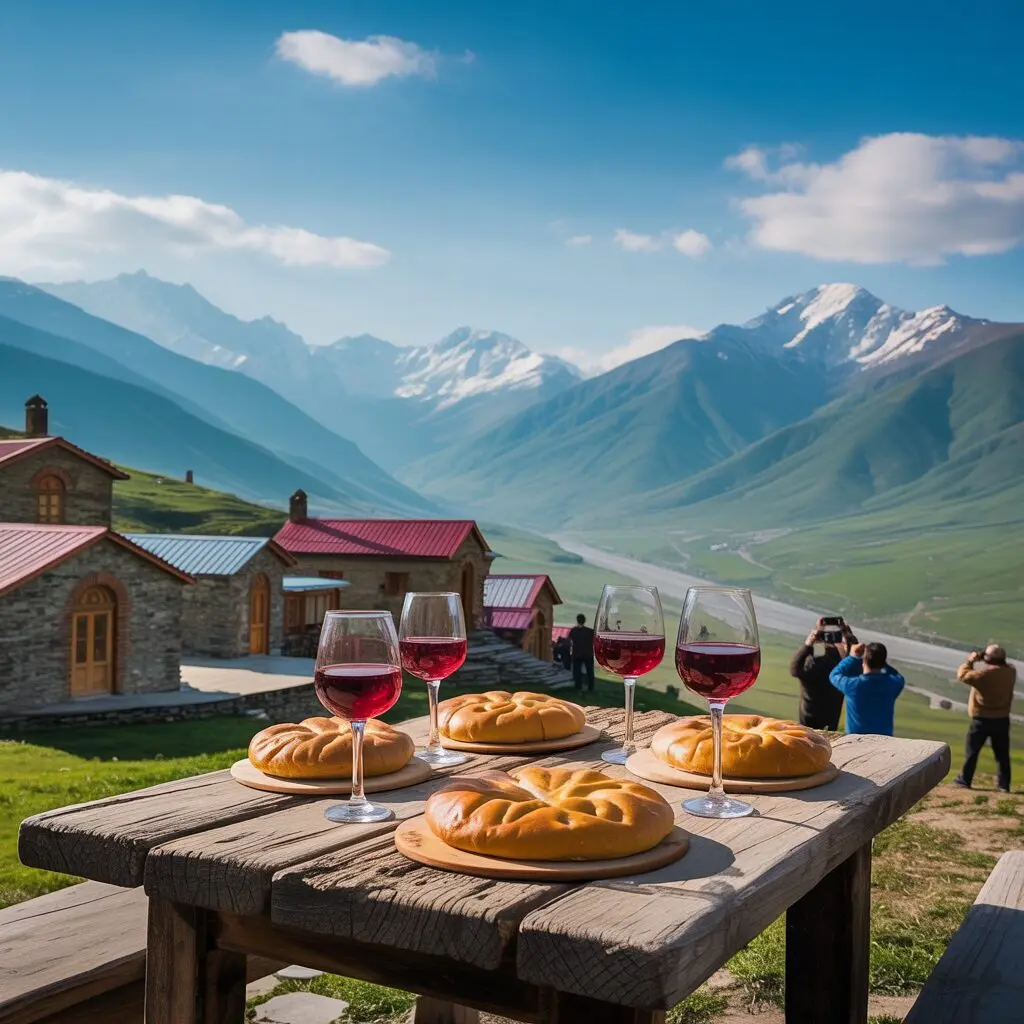
A Georgian feast (supra) is a cultural experience: a long table covered with many dishes (cold starters/pkhali, warm dishes, meats, salads), all accompanied by wine and toasts led by a tamada (toastmaster). If invited to a Georgian home for supra, accept – it is one of the most memorable experiences Georgia offers. Pace yourself with the wine.
Wine
Georgia is one of the world’s oldest wine-producing nations. Try: Rkatsiteli (white, sometimes amber/orange), Saperavi (deep red), and traditional qvevri amber wines. Natural wine bars in Tbilisi are excellent. Kakheti wine tours are a highlight of any Georgia trip.
Tap Water
Tap water is generally safe to drink in Tbilisi and major cities. In rural areas, use bottled water. Georgia has abundant natural mineral water springs – Borjomi mineral water is world-famous.
Safety Tips for Georgia 2026
- Georgia is generally safe for tourists. Petty theft in crowded areas is possible; keep valuables secure
- Avoid Abkhazia and South Ossetia entirely – these regions are unsafe and illegal to enter from the Russian side
- Mountain areas carry natural hazards (altitude, weather changes, unmarked trails) – hike with appropriate preparation and inform someone of your route
- Traffic in Tbilisi can be chaotic – cross roads with care
- Medical facilities outside Tbilisi are limited – comprehensive travel insurance with medical evacuation coverage is important
Cultural Etiquette
- Remove shoes when entering someone’s home
- Dress modestly when visiting churches – women should cover their hair (scarves are usually available at church entrances)
- Refusng hospitality (offered tea, snacks, food) can be seen as impolite – accept graciously even if you take only a small amount
- Photography: always ask before photographing people, especially in rural areas
- Bargaining is not common in shops with fixed prices but is expected in outdoor markets
For full entry requirements including visa and insurance, see our Georgia entry requirements 2026 guide. For the complete destination overview, see our Georgia Travel Guide 2026.
Frequently Asked Questions
What should I pack for a trip to Georgia?
Layers are key – Georgia’s climate varies widely by region and altitude. For Tbilisi in summer: light clothing, sunscreen, comfortable walking shoes. For mountain areas: warm layers, waterproof jacket, good hiking boots. For church visits: a scarf (women) and covered shoulders. A universal travel adapter (Georgia uses European 220V/50Hz Type C/F sockets).
Is it easy to get a SIM card in Georgia?
Very easy. Pick up a local SIM at Tbilisi Airport or any major phone shop in the city. Silknet, Magti, and Beeline are the main providers. A SIM with data costs around 15-30 GEL. Coverage is good in cities and main roads; patchy in remote mountain areas. Passport required for registration.
Can I drink alcohol freely in Georgia?
Yes. Georgia has a relaxed attitude toward alcohol consumption. Wine, beer, and chacha (Georgian grape brandy) are widely available and inexpensive. Public drinking is generally tolerated. The drinking age is 18. Driving under the influence carries zero tolerance (0.0% BAC limit for drivers).
What are Georgia’s public holidays in 2026?
Key Georgian public holidays: January 1-2 (New Year), January 7 (Orthodox Christmas), March 3 (Mother’s Day), April 9 (National Unity Day), May 9 (Victory Day), May 12 (Saint Andrew’s Day), May 26 (Independence Day), August 28 (Mariamoba), October 14 (Svetitskhovloba), November 23 (Giorgoba). Many businesses close on these days.